The Scale of the Cosmos
To truly grasp the size of the universe, we have to climb a celestial ladder, starting with our cosmic backyard and moving all the way out to the edge of everything we can see.
1. Planet Size Comparison
When we look at our solar system, we generally divide planets into two categories: the small, rocky inner planets and the massive, gaseous outer planets.
-
-
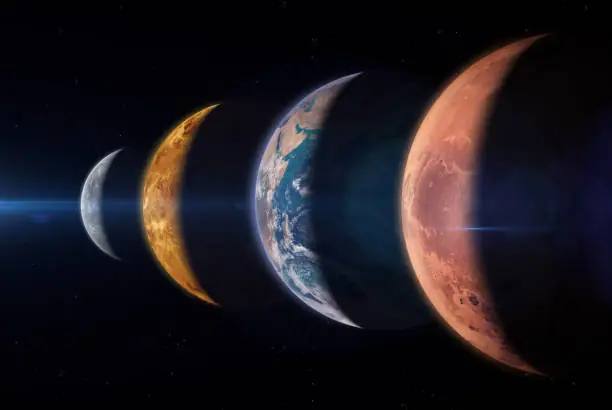
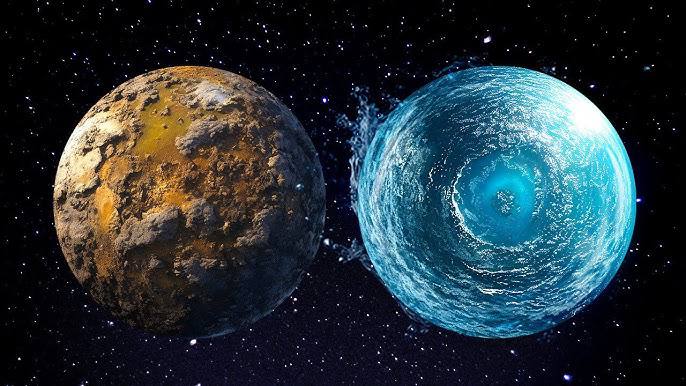
Mercury, Mars, and Venus: Mercury is the smallest planet (barely larger than Earth’s Moon). Mars is about half the size of Earth. Venus is often called Earth’s twin because it is nearly identical in size, measuring about 95% of Earth’s diameter.
-
Earth (The Baseline): Earth has a diameter of roughly 12,742 kilometers (7,917 miles).
-
The Gas Giants (Jupiter and Saturn): Jupiter is the undisputed king of our solar system. You could fit about 1,300 Earths inside Jupiter. Saturn is slightly smaller but famously possesses a massive ring system that spans over 282,000 kilometers.
-
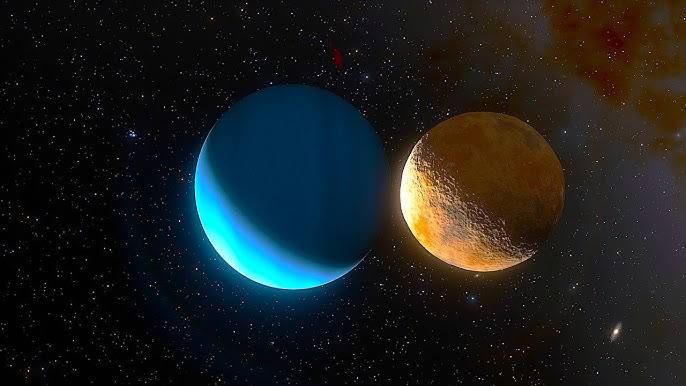
The Ice Giants (Uranus and Neptune): These planets are roughly four times wider than Earth. You could fit about 60 Earths inside Neptune.
-
2. Stars Size Comparison
Once we leave planets behind, the scale of the universe explodes. Planets are microscopic compared to the stars they orbit.
-
Our Sun (A Yellow Dwarf): The Sun seems mind-bogglingly massive to us—it makes up 99.8% of the mass in our solar system, and you could fit 1.3 million Earths inside it. However, in the grand cosmic stellar lineup, our Sun is just an average, medium-sized star.
-
Sirius A and Pollux: Sirius A (the brightest star in our night sky) is about twice the mass of the Sun. Pollux, a red giant star, is roughly 9 times wider than our Sun.
-
Rigel and Betelgeuse (Orion Constellation): Rigel is a blue supergiant that is about 79 times wider than the Sun. Betelgeuse, a red supergiant in the same constellation, is so massive that if you placed it in the center of our solar system, it would swallow Mercury, Venus, Earth, Mars, and Jupiter.
-
UY Scuti / Stephenson 2-18 (The Hypergiants): These are among the largest known stars in the universe. Stephenson 2-18 is roughly 2,150 times wider than our Sun. If you replaced our Sun with Stephenson 2-18, it would engulf the solar system all the way out to Saturn.
3. The Ultimate Universe Scale
Stars are just the building blocks of galaxies, and galaxies are just the building blocks of the observable universe.
-
The Solar System: The distance from the Sun to Pluto is about 5.9 billion kilometers. Light takes about 5.5 hours to travel this distance.
-
The Milky Way Galaxy: Our solar system orbits the center of the Milky Way, a spiral galaxy containing 100 to 400 billion stars. The Milky Way is about 100,000 light-years across (one light-year is about 9.5 trillion kilometers).
-
The Local Group: This is our galactic neighborhood, spanning about 10 million light-years. It includes the Milky Way, the Andromeda Galaxy, and about 50 other smaller satellite galaxies.
-
Superclusters (e.g., Laniakea): Galaxies cluster together into massive webs called superclusters. Our Local Group belongs to the Laniakea Supercluster, which contains roughly 100,000 galaxies and stretches across 520 million light-years.
-
The Observable Universe: This is the absolute limit of what humans can see from Earth, restricted by the speed of light and the age of the universe. It is a sphere that spans roughly 93 billion light-years in diameter and contains an estimated 2 trillion galaxies.
Summary of the Scale
To put it all into perspective: If the Earth were scaled down to the size of a tiny grain of sand (1 millimeter):
-
Jupiter would be the size of a marble.
-
The Sun would be the size of a beach ball.
-
Stephenson 2-18 would be the height of a 30-story skyscraper.
-
The Milky Way Galaxy would span from Earth to past the orbit of Mars.